The most transformative AI applications will come from people who can't code
Last week, a cardiologist who'd never written a line of code placed third in a coding competition. Out of 13,000 applicants. He built it in seven days. While working his hospital shifts.
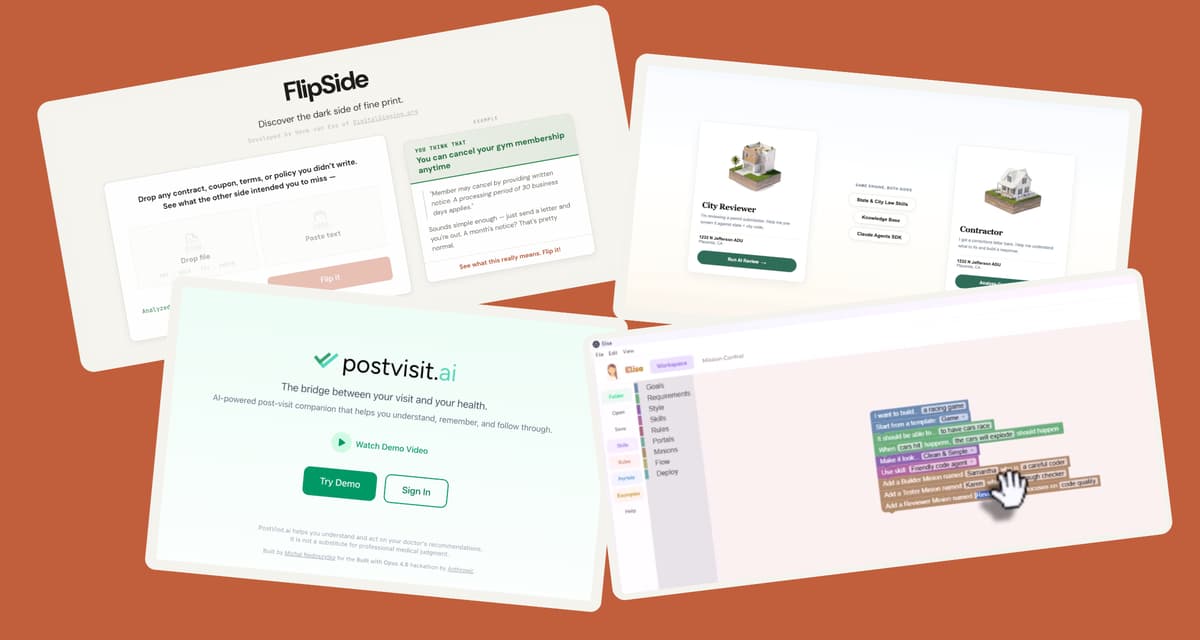
The Claude Code hackathon gave 500 builders a week to create something with Anthropic's Claude Code and Opus 4.6. The five winners were a personal injury attorney, a software engineer, an interventional cardiologist, an electronic musician, and an infrastructure and roads systems worker.
One software engineer out of five.
https://twitter.com/0xkyle__/status/2025398536712716332
The cardiologist, Michal Nedoszytko, works in a cath lab in Brussels. He's done thousands of procedures. But he says the real struggle begins the moment the patient leaves the room. They don't understand their diagnosis. They don't remember what the doctor said. They go home confused.
So he built postvisit.ai, a tool that turns visit transcripts and medical records into personalised, ongoing health guidance.
First place went to Mike Brown, a personal injury attorney. He built CrossBeam, a tool to speed up California's building permit process. Not because he knew how to code, but because he'd spent years drowning in the problem.
There's a pattern here. The winning projects weren't technically impressive for the sake of it. They were built by people who understood a problem so deeply that the moment the technical barrier dropped, they knew exactly what to make.
Boris Cherny, the creator of Claude Code, said on Lenny's Podcast last Thursday: "Coding is largely solved. At least for the kinds of programming that I do, it's just a solved problem."
If that's true, and 277 hackathon projects in six days suggests it might be, the bottleneck has shifted. The scarce resource isn't technical skill anymore. It's domain knowledge. Knowing what to build. Knowing when the machine got it wrong.
A cardiologist knows that patients leave confused. A lawyer knows that permit corrections cost builders months. A roads inspector knows where infrastructure data falls through the cracks. No amount of engineering talent gives you that insight. You have to have lived it.
This is where it gets interesting.
Because if domain expertise is the new bottleneck, the question becomes: how many domain experts are actually using these tools?
The answer is almost none.
A chart by Damian Player this week puts it in perspective. Each dot represents 3.2 million people. 2,500 dots for 8.1 billion humans. The colour tells you their most advanced interaction with AI.
https://twitter.com/damianplayer/status/2025234388137468387
84% of the world's population has never used a generative AI tool. 16% have used a free chatbot. 0.3% pay for one. 0.04% use AI to write code.
If you've ever typed a prompt into ChatGPT, you're ahead of 6.8 billion people by AI adoption. If you pay $20 a month, you're in a club smaller than the population of Australia.
The AI conversation on LinkedIn and X is dominated by a tiny, unrepresentative sliver of the population talking to itself about model benchmarks and agent frameworks. It feels like everyone's already in the pool. They're not. Almost nobody is.
And the hackathon just showed us what happens when they jump in.
Every cardiologist who hasn't started yet is a potential Michal. Every lawyer wrestling with broken processes is a potential Mike Brown. Every professional sitting on decades of domain expertise, who currently thinks AI is "that thing my kid uses for homework," is sitting on a problem worth solving that no engineer would think to build for.
The AI revolution, as it's currently discussed, is a conversation among the 0.3% about what the 0.3% are building for the 0.3%. That's not the revolution. That's the warm-up.
The real revolution will start when the grey dots turn green.
Enjoyed this? I write occasionally about politics, tech, and media.