Strategy is a choice, not a plan
A Twitter thread got me thinking about one of the most common mistakes I see almost every day in my work.
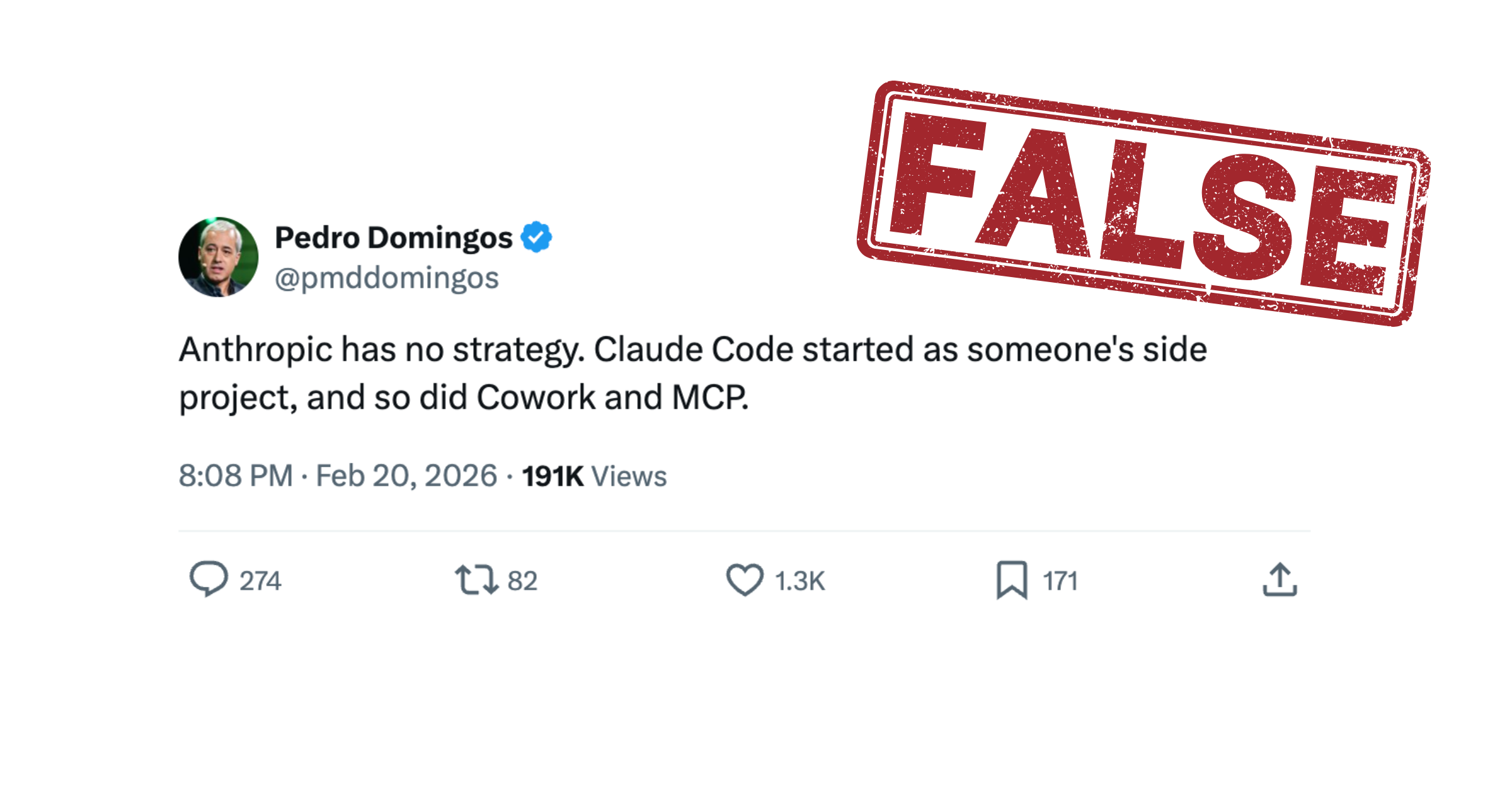
Pedro Domingos, a well-known AI researcher, claimed that Anthropic has no strategy. His evidence? Claude Code started as someone's side project. So did Cowork. So did MCP. No grand plan, no top-down roadmap. Ergo, no strategy.
He's wrong. But he's wrong in a way that's incredibly common, and incredibly costly.
He's confusing a plan with a strategy.
The mistake almost everyone makes
Most organisations think they have a strategy. What they actually have is a plan. Sometimes it's a 50-page McKinsey deck. Sometimes it's a set of OKRs. Sometimes it's a CEO's vision statement laminated on the office wall. These are all fine things to have. None of them are a strategy.
A plan is a sequence of actions. A strategy is a choice.
Specifically, a strategy is the choice you make about how to get from where you are to where you want to be. It results in a plan, but the plan is the output, not the thing itself.
The test is simple: is there a credible alternative? If there isn't, you don't have a strategy. You have an aspiration.
"We want to grow revenue by 20%" IS NOT a strategy. Nobody is choosing not to grow revenue.
"We will grow revenue by focusing exclusively on enterprise clients and walking away from small business" IS a strategy, because the opposite choice (doubling down on small business) is a perfectly viable path someone else might take.
Why this matters
The plan-strategy confusion isn't just semantic. It has real consequences.
When leaders mistake plans for strategy, they optimise for detail instead of clarity. They spend months refining implementation timelines when they haven't actually made the hard choices about direction. They end up with beautifully formatted documents that describe what they'll do without explaining why this path and not another.
The result is organisations that are busy but not directed. Every team has a roadmap. Nobody can explain the underlying logic that connects them.
Worse, it creates a false sense of security. The plan exists, therefore we have a strategy. The deck has been approved, therefore we've made the hard decisions. But the hard decisions never actually got made.
Strategy is a list of things you're not doing
A real strategy is not a list of things you will do. It's a list of things you have chosen not to do.
When Steve Jobs returned to Apple in 1997, the company was producing dozens of products. Jobs killed 70% of the product line. He drew a simple two-by-two grid: consumer and professional, desktop and portable. Four products. Everything else was gone.
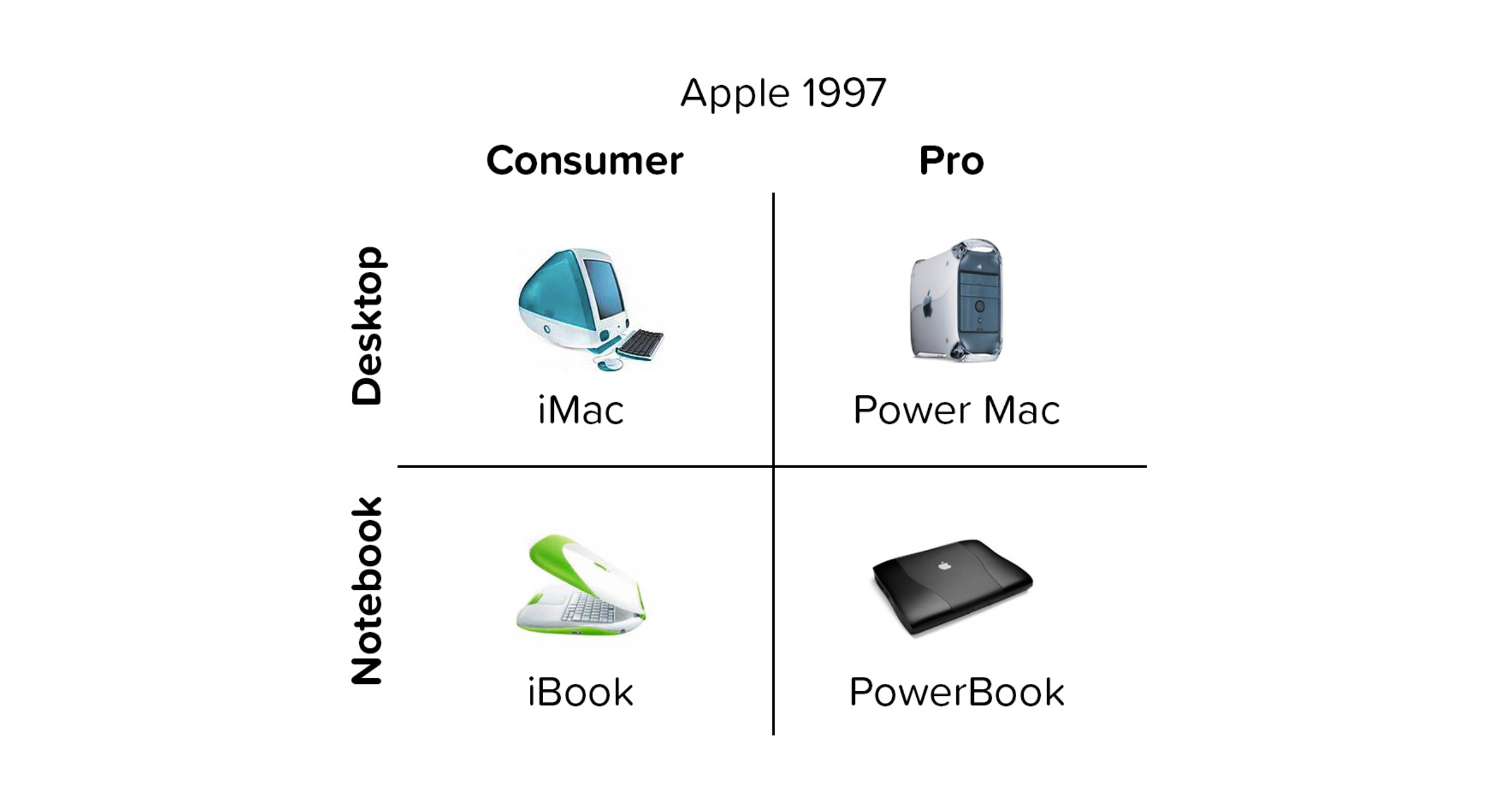
The strategy wasn't what Apple decided to build. It was the dozens of things they decided to stop building.
Southwest Airlines built one of the most successful airlines in history the same way. No assigned seating. No hub airports. No meals. No interline baggage transfers. No first class. Every major competitor tried to offer everything to everyone. Southwest's strategy was a list of things they would not do, and every one of those refusals reinforced the others.
IKEA is perhaps the most studied example in business school for exactly this reason. No sales assistance. No delivery. No assembled products. No premium materials. Michael Porter, the Harvard professor who essentially wrote the book on competitive strategy, uses IKEA to teach strategy because its defining choices are all negatives. The things IKEA refuses to do are what make the things it does do possible.
In each case, the strategy isn't the plan. It's the set of trade-offs that make the plan coherent.
Back to Anthropic
This is why Domingos got it wrong about Anthropic. He looked for a plan, a pre-authored product roadmap, and couldn't find one. But the strategy was obvious.
Anthropic made a choice: build an organisation where exceptionally talented engineers have extreme autonomy, can pursue side projects, and can ship things without layers of approval. That is a strategy. It's a clear choice with a clear alternative. Most technology companies choose centralised planning, stage-gate processes, and top-down prioritisation instead.
Claude Code, MCP, and Cowork aren't evidence of a missing strategy. They're what the strategy was designed to produce. The whole point was to create conditions where things like this could happen, even if you couldn't predict what specifically would emerge.
You could argue it's a risky strategy. You could argue it only works at certain scales or with certain talent densities. But you can't argue it isn't a strategy just because it didn't come with a Gantt chart.
Strategy is hard because choosing is hard
None of this is a failure of intelligence. It's a failure of nerve.
Making a real strategic choice means closing doors. It means saying "we will not pursue this market" or "we are walking away from this capability" and accepting that you might be wrong.
A plan can't be proven wrong until it's been executed. A strategy can feel wrong the moment you say it out loud, because someone in the room will immediately point to the opportunity you're leaving on the table.
That fear is why most organisations default to plans. Planning is comfortable. You can spend six months building a detailed implementation roadmap and feel productive without ever having committed to a bet.
Strategy requires you to commit to a bet, and most corporate cultures punish being wrong more than they reward being bold.
This is also why the word "strategy" gets attached to everything. You end up with a social media strategy, a data strategy, a content strategy, a hiring strategy, a partnerships strategy. But if none of those documents contain a trade-off, if none of them articulate what you've chosen not to do, they aren't strategies. They're activity lists with an ambitious title. The word gets used so freely it loses its meaning.
And that's part of the problem. It's easier to label something strategic than to make a strategic choice.
Everyone faces this. If you've ever sat in a room where the "strategy" discussion was really just a planning discussion, where nobody was willing to name the thing you should stop doing, you know exactly what I'm talking about.
Making better strategies
If you're responsible for strategy in your organisation, here's what I'd suggest.
- Start with what you're choosing not to do. Before you write a single slide, try to express your strategy as a list of refusals. What markets are you not entering? What customers are you not serving? What capabilities are you not building? If you can't name what you're giving up, you haven't found your strategy yet.
- Stress-test it by looking for the opposite. A good strategy should have an intelligent counterargument. If nobody reasonable would choose the opposite path, your strategy is probably just a goal dressed up in strategic language.
- Keep it short. If your strategy can't be explained in a few sentences, it's probably a plan masquerading as a strategy. The choice itself should be crisp. The plan that follows can be as detailed as you need.
- Accept that it will be uncomfortable. Real strategic choices involve trade-offs. They mean saying no to good things to focus on better things. If your strategy doesn't make anyone in the room nervous, it probably isn't one.
The takeaway
A plan tells you what to do. A strategy tells you what you've decided not to do, and why.
Most organisations have plenty of plans. Far fewer have actually made a strategy.
Try this: take your current strategy document and rewrite it as a list of things you've decided not to do. If you can't, you know what you actually have.
It's worth checking which one yours is.
Enjoyed this? I write occasionally about politics, tech, and media.