This chart is a roadmap of which industries get transformed next
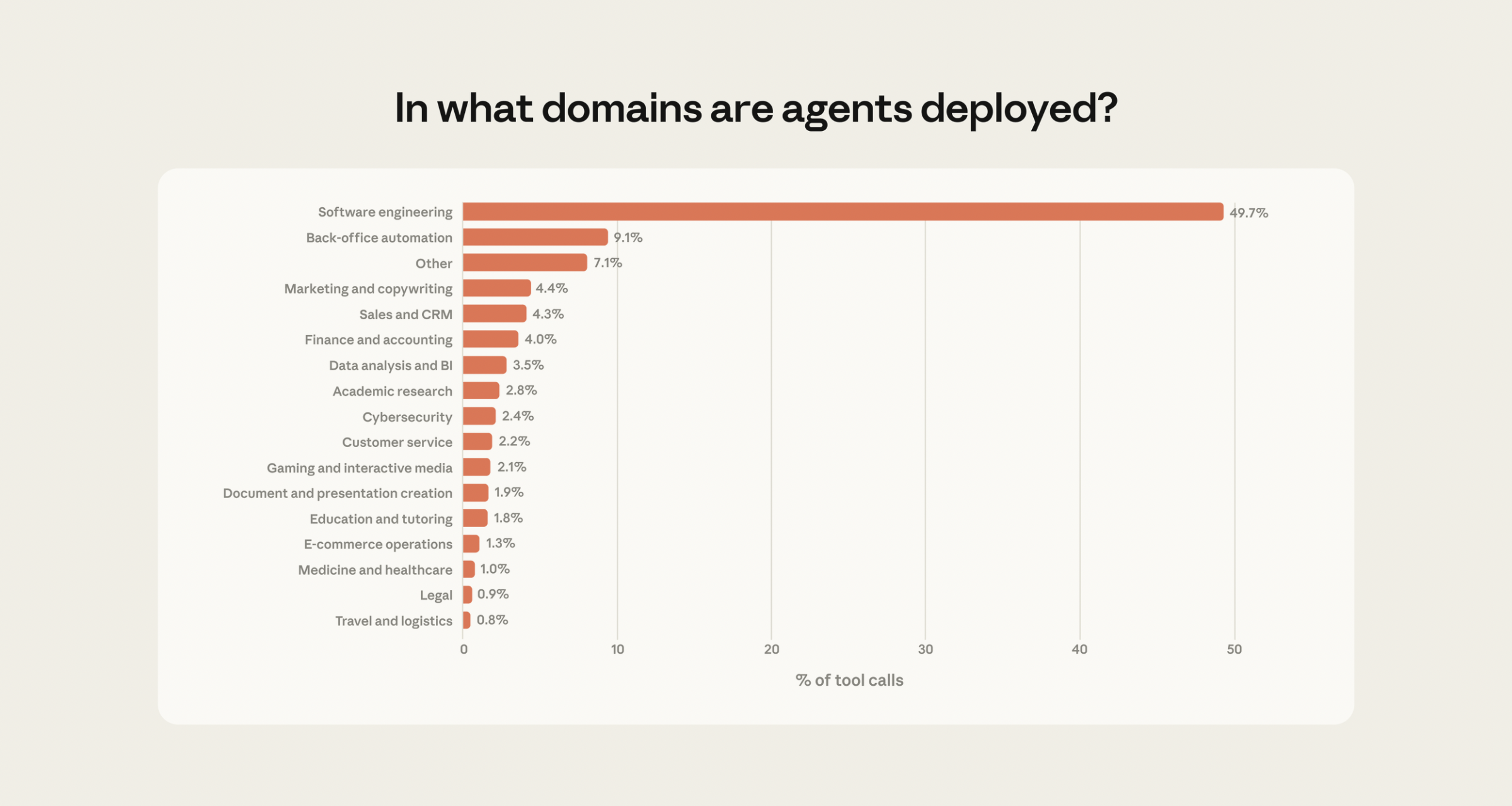
Anthropic published something this week that most people scrolled past. A chart showing which domains their AI agents are being deployed in, based on millions of tool calls through their API.
Software engineering sits at the top with 49.7%. No surprise there. Developers were the earliest adopters of AI tools, they're the most technically literate users, and the feedback loops are tight: the code either works or it doesn't. They're furthest along the adoption curve.
But the interesting part isn't the top of the chart. It's everything underneath it.
Back-office automation at 9.1%. Marketing and copywriting at 4.4%. Sales and CRM at 4.3%. Finance and accounting at 4.0%. Then data analysis, academic research, cybersecurity, customer service, gaming, education, healthcare, legal, travel, all trailing behind between 3.5% and 0.8%.
Now here's what I think is worth paying attention to. I don't think this is just a snapshot of where things stand today. I think it's roughly the order in which these industries will be transformed.
Each category represents a different point on the same adoption curve. Software engineering is out in front because the early adopters there had the skills and the incentive to move first. Back-office automation is next because the tasks are structured and repetitive, with clear rules. And those categories sitting between 1% and 5%? They're where the early adopters within each industry are just getting started.
The pattern makes intuitive sense once you think about what makes a domain easy or hard for agents to operate in. Software has clear inputs, clear outputs, and low-risk failure modes. You can revert the commit. Back-office automation is similar: invoices, data entry, scheduling. The kind of work that was already being semi-automated before LLMs arrived.
But then you hit the middle of the chart, and the stakes start to change. Marketing requires judgment about tone and audience. Sales involves relationship dynamics that are harder to codify. Finance demands accuracy with real consequences for getting it wrong.
These aren't impossible problems for AI agents. They're just harder ones. And the data suggests they're being tackled right now, just at lower volumes while people figure out the right level of human oversight.
The Anthropic research tells us something else worth knowing. Among the longest-running Claude Code sessions, the time the AI works autonomously before pausing has nearly doubled in three months, from under 25 minutes to over 45. New users let the AI run unsupervised about 20% of the time. By 750 sessions, that's over 40%.
And here's the detail I found most interesting: on complex tasks, the AI stops itself to ask for clarification more often than humans interrupt it. It's not just getting more capable. It's developing something that looks a lot like knowing what it doesn't know.
The agents are getting more capable. The humans are getting more comfortable letting them run. That combination is what turns a 4% category into a 40% one.
At Topham Guerin, we sit right in the middle of this chart. Marketing, copywriting, strategy, research. All on there. And we've been building AI into our workflows for the past couple of years, not to replace people, but to make good people faster. To turn a week of research into a day. To test twenty creative approaches instead of three.
The work still needs taste. It still needs judgment. Someone who knows when the AI output is brilliant and when it's generic nonsense. But the ceiling of what a small team can achieve has shifted dramatically.
If your industry is sitting at 1-5% on that chart, you're in a window right now. Not a crisis. A window. The companies in your space who are experimenting with custom agents today are building an advantage that compounds quietly, until it doesn't.
The question is whether you're the early adopter in your sector, or whether you're waiting to see what happens.
Because the queue is already forming. And it's moving faster than most people think.
Enjoyed this? I write occasionally about politics, tech, and media.