The real AI skill isn't prompting. It's taste
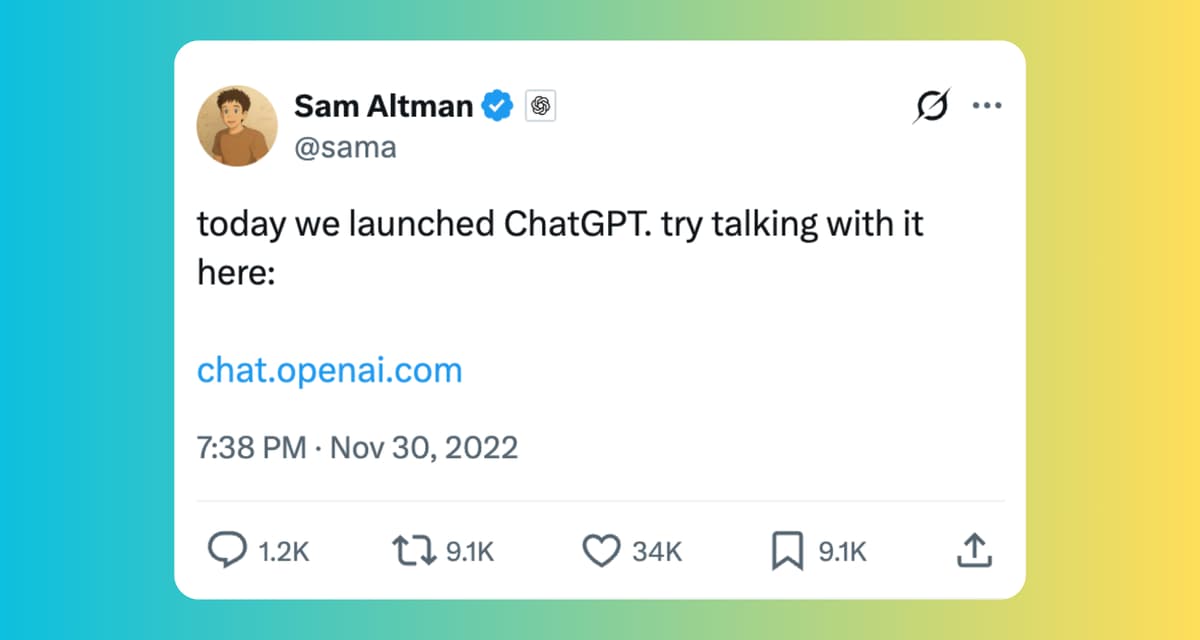
Three years ago today, Sam Altman tweeted "try talking to ChatGPT."
You could argue it's since been overtaken. Grok for real-time analysis. Claude for coding. Gemini for complex visuals. But none of that matters. This was the moment AI became mainstream.
Three years on, the dramatic predictions haven't landed. No mass unemployment. No industries wiped out overnight. The apocalypse keeps getting postponed.
The real shift has been subtler. A widening gap between people using these tools well and those who aren't. Work that took days now takes hours, if you know what you're doing.
Prompt engineering is overrated
There's been enormous noise about "prompt engineering" as a killer skill. Courses, certifications, job titles. A whole cottage industry built around crafting the perfect instruction.
I think it's overrated.
The models are getting better at understanding intent. A year ago, you needed elaborate prompts with specific formatting instructions and role-play setups. Now you can often just ask for what you want. The gap between a mediocre prompt and a good one is shrinking with every model update.
What isn't shrinking is the gap between people who can recognise good output and those who can't.
Taste is the real skill
Here's what I mean by taste: the ability to look at what the AI produces and know, immediately, whether it's good enough or whether it's trash.
This sounds simple. It isn't.
I've watched people accept AI outputs that are obviously wrong, obviously generic, obviously not what they asked for. They can't tell. They don't have the reference points to recognise quality in that domain.
And I've watched people with deep expertise in a field reject AI outputs that are 90% there, because they can see the 10% that's off. They know what good looks like, so they know when they're not looking at it.
The difference isn't in how they prompt. It's in how they evaluate.
What taste looks like in practice
In writing, taste means recognising when AI prose is bloated, generic, or structurally predictable. When it's using filler phrases. When it's hedging everything into meaninglessness. When it sounds like every other AI output.
In code, taste means knowing when the solution is elegant versus when it's a brittle hack that will break in edge cases. When the architecture makes sense versus when it's overengineered nonsense the model hallucinated from Stack Overflow fragments.
In strategy, taste means spotting when the AI has given you a plausible-sounding framework that doesn't actually fit your situation. When it's pattern-matched to something superficially similar but fundamentally different.
In all cases, the skill is the same: knowing what good looks like in that domain, and therefore knowing when you're not looking at it.
You can't outsource judgment
This connects to something I've been thinking about with AI and junior hiring.
Research from Harvard shows junior hiring at AI-adopting firms is down 22% since early 2023. The logic is obvious. If AI can do the entry-level knowledge work, why hire entry-level people to do it?
But here's the problem. Taste comes from exposure. You develop judgment by seeing thousands of examples of good and bad work, by making mistakes, by having someone more experienced tell you why your output isn't good enough.
If we stop training juniors, we stop developing the taste that makes AI useful. We end up with a generation that can prompt but can't evaluate. That can generate but can't judge.
The models will keep getting better at producing output. The bottleneck will be humans who can tell whether the output is worth anything.
Three years in
So where does that leave us, three years after ChatGPT launched?
The tools are better than most people expected. The disruption is slower than the headlines predicted. The gap between skilled users and everyone else is wider than either camp anticipated.
The people getting the most value aren't necessarily the best prompters. They're the ones who already knew what good looked like in their domain, and can now produce it faster.
As for which models we'll be using in twelve months? Who knows. But the genie isn't going back in the bottle. And the skill that will matter most isn't learning the perfect prompt syntax. It's developing the judgment to know when the output is good enough to ship.
That takes years of practice. No shortcut. No course. Just reps.
Enjoyed this? I write occasionally about politics, tech, and media.