What's really behind Gen Z's personality shift?
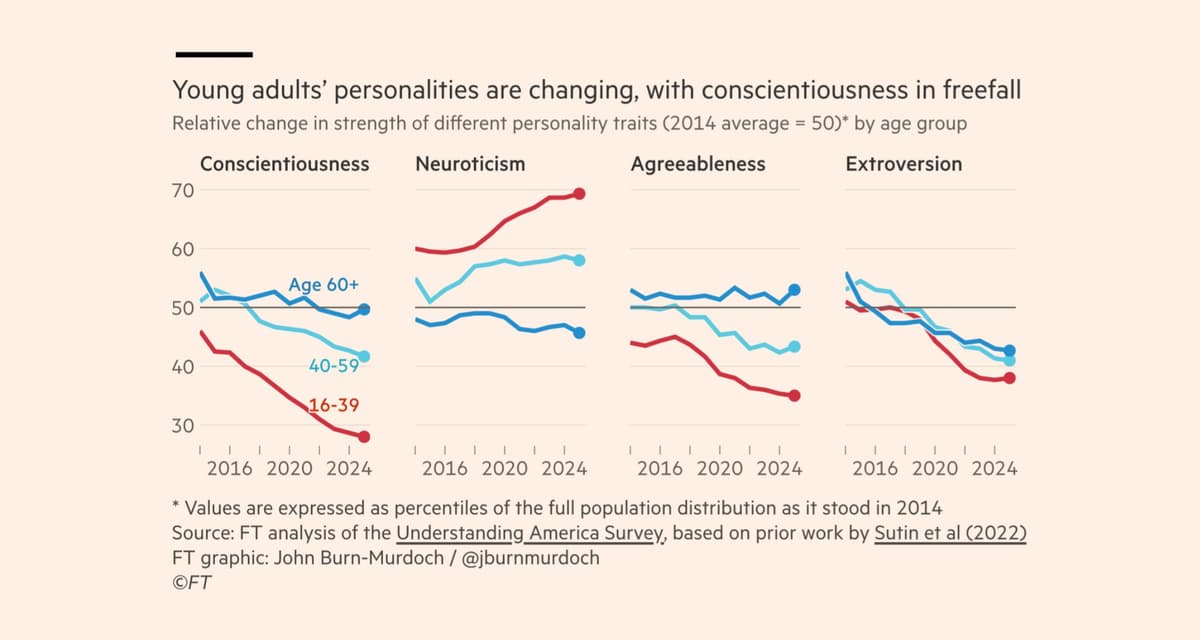
This is one of those charts that stops you in your tracks.
The Financial Times analysed the University of Southern California's "Understanding America Survey" and the results confirm what everyone suspects: young people today really are wired differently.
Since 2014, the personality profiles of 16-39 year olds have diverged sharply from everyone else. The over-60s have barely moved. But young adults? The lines are falling off a cliff.
Conscientiousness has dropped from around 45 to below 30. More procrastination, more missed commitments, less self-discipline.
Neuroticism has spiked from the low 50s to nearly 70. More anxiety, more stress, more emotional volatility.
Agreeableness is down. Less trust, less deference to authority, less willingness to compromise.
Extroversion is declining across all ages, but steepest among the young. Smaller circles, fewer big social settings.
The obvious explanation
Social media. Smartphones. The dopamine treadmill of infinite scrolling. The comparison trap of curated feeds. Jonathan Haidt has written extensively on this and he's probably right.
But I think this explanation, while probably true, is incomplete.
The less comfortable explanation
Consider what it means to be 22 in 2025:
You took on student debt because you were told education was the path to success.
You graduated into a job market where "entry-level" means three years' experience.
House prices are ten times the average salary.
The triple lock guarantees your grandparents' pension rises faster than your wages.
By the time you retire, the state pension will likely have collapsed or been reformed beyond recognition.
Many Gen Zers I speak to don't see the point of playing by the rules when the game is rigged.
And when you frame it that way, the data looks different.
Why invest in long-term planning when the long term feels uncertain? That's conscientiousness declining.
Why wouldn't you be anxious when housing is unaffordable and the climate science is terrifying? That's neuroticism rising.
Why defer to institutions that keep failing to deliver? That's agreeableness dropping.
Why engage with a public sphere where every interaction is monetised and recorded? That's extroversion retreating.
The pattern
Every generation gets told it's uniquely broken. Boomers were self-indulgent hippies. Gen X were cynical slackers. Millennials were entitled snowflakes. Now Gen Z are anxious introverts who can't commit.
The consistency should make us suspicious.
What actually matters
Looking at this chart, it's easy to ask "what's wrong with young people?"
But surely it's better to ask: why shouldn't they feel this way?
The mental health crisis is real. The skills gap is genuine. But if we treat these shifts as pathology, we design interventions to fix broken individuals. If we treat them as adaptation, we ask harder questions about what they're adapting to.
My guess is we'll get the former: resilience training, mental health apps, productivity hacks. All designed to help people cope with systems that stay unchanged.
The data suggests something harder to accept. The problem might not be the kids. The problem might be what we've built for them to inherit.
Enjoyed this? I write occasionally about politics, tech, and media.