Making content at scale with AI requires a whole new set of skills. I call it "AI ProductionOps"
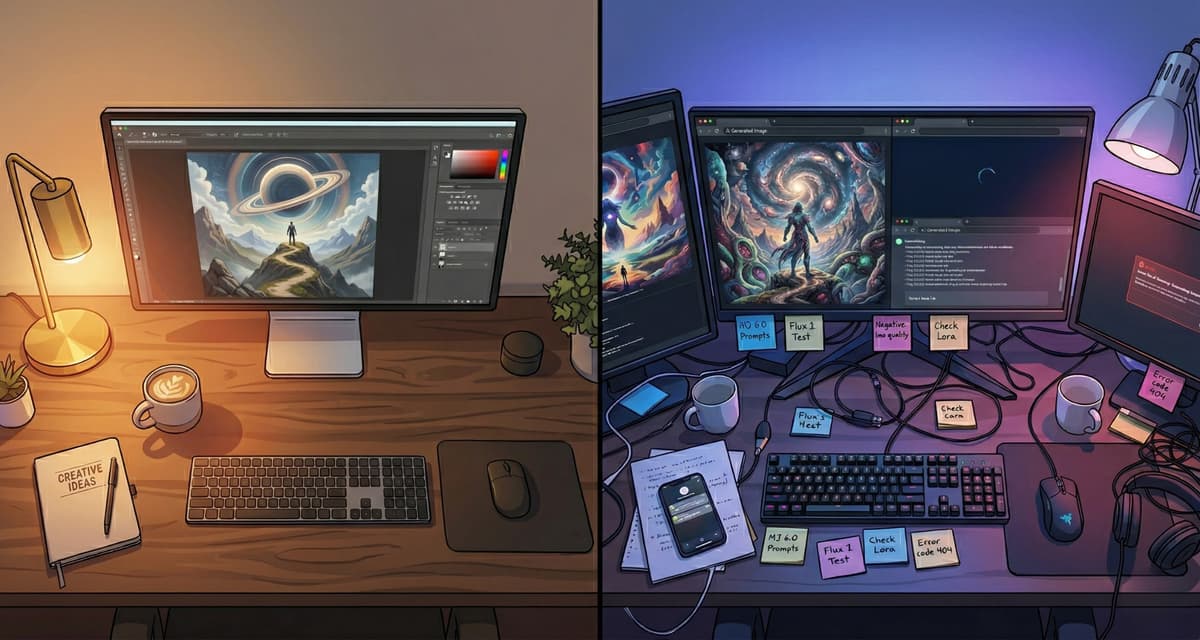
With Photoshop, Illustrator, Premiere Pro and After Effects, the tool just worked. You opened it, it was there, it did the thing. Every time. Reliably. For years.
Nobody had a fallback workflow for Photoshop crashing. Because it didn't.
AI creative tools don't work like that. They're more powerful than anything the creative industry has ever had access to. They're also less reliable than anything the creative industry has ever depended on.
That gap between power and reliability is creating something that, at the risk of sounding like a LinkedIn thought leader, I've been calling AI ProductionOps. It's not a phrase I'm particularly impressed by. But there genuinely isn't a word for this yet, and the lack of one is part of the problem.
The routing problem
At Topham Guerin, our creative team works across multiple AI tools every day because each tool does something different, and none of them do everything to the standard we need the fina outputs to be at.
Kling is our go-to for video, especially when we need frame-to-frame consistency between a start image and an end image. Best in class for that. But it's often overloaded, and when it's down, there's no obvious replacement. You just wait. Try explaining that to a client on a deadline.
Gemini handles detail brilliantly. If you need precision in an image, accurate text rendering, or complex compositions, it's the strongest option right now. Midjourney is better for atmosphere and scenes, the kind of output where mood matters more than accuracy.
Different tools, different strengths, same brief. The team needs to know which model handles which style, and when to switch.
When it comes to agentic software development, Opus 4.6 in Claude Code is exceptional at handling complex web builds, and working with it feels like chatting to a peer on slack. But it often misses small details and can get tangled up when debugging, which is where we turn to Codex and the GPT 4.5 family of models for precision and hyperfocus.
Claude Code is much better at seeing the big picture, but Codex is more reliable at handling complex details.
The volatility problem
Every week there's something new. A model update changes the output quality of a tool you'd finally figured out. A new feature appears that solves a problem you'd been working around for months. A pricing change makes your primary tool uneconomical overnight.
The old creative tools were less powerful but reliable. The new ones are more powerful but volatile. That's just the reality of working with technology that's evolving this fast.
And it creates an operational challenge that most agencies haven't thought about yet. When your primary video tool goes offline during a client delivery, what's the fallback? When a model update changes the visual style of outputs you've been producing for weeks, how do you maintain consistency? When a new tool launches that's genuinely better than what you're using, how quickly can the team evaluate and switch?
These aren't creative questions. They're operational ones. And they need someone thinking about them before the deadline arrives.
What the team actually needs
The creative skill hasn't changed. You still need people with taste, with judgment, with the ability to look at AI output and know immediately whether it's good enough or whether it's generic nonsense.
But on top of that, the team now needs:
1. Knowledge of which model handles which style, and when to switch between them.
2. A way to maintain visual consistency across outputs from different tools.
3. Fallback workflows for when the primary tool is throttled or offline.
4. Time carved out just to stay current, because the toolkit shifts constantly.
That last one is easy to underestimate. Keeping up with the tools isn't a nice-to-have. It's operational overhead that has to be budgeted for, just like training on any other production platform. Except this one changes every month instead of every year.
The bigger point
There's a reason I think this matters beyond our own workflow at TG.
The conversation about AI in creative agencies is almost entirely about output. Can AI make images? Can it generate video? Can it write copy? The answer to all of those is yes, often impressively well.
But almost nobody is talking about the operational layer underneath. The routing decisions, the fallback plans, the consistency management, the tool evaluation cadence. The infrastructure of actually shipping creative work with these tools, reliably, on deadline, at a standard clients will accept.
That's AI ProductionOps. And the agencies that build this discipline first will have a significant advantage over those still treating AI tools like a single-player creative shortcut.
Because the tools are going to keep getting better. They're also going to keep changing. And the gap between "we use AI" and "we have a system for using AI" is where the real competitive advantage lives.
Enjoyed this? I write occasionally about politics, tech, and media.