A folder full of skill files isn't going to replace an agency any time soon
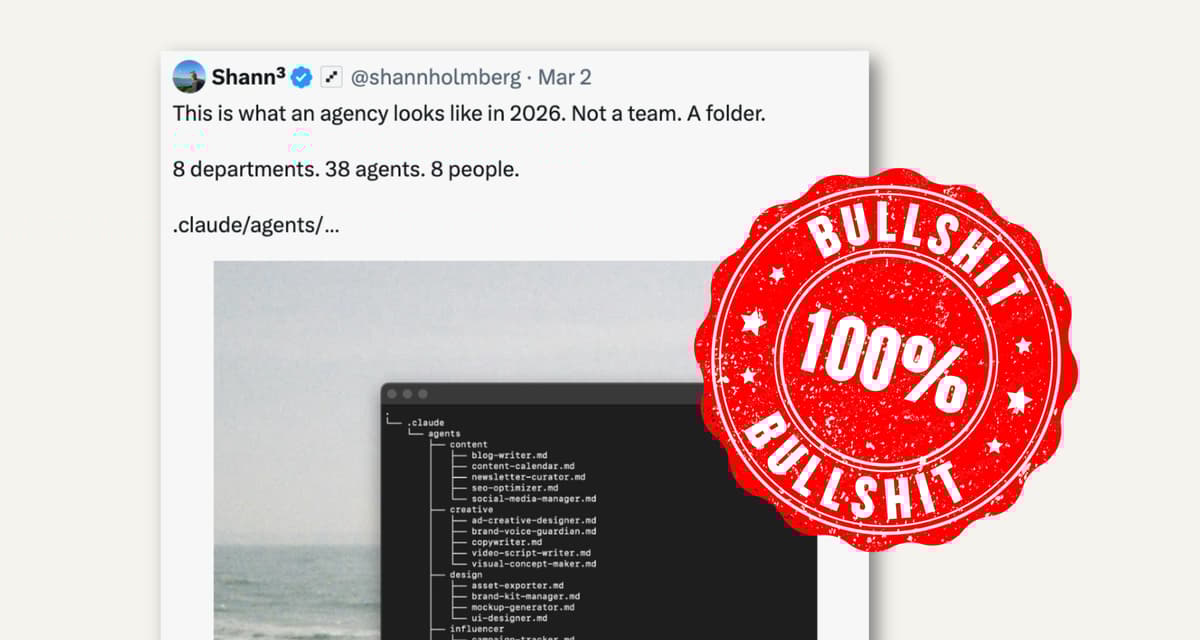
Someone posted a screenshot of a .claude directory this week. Eight departments. Thirty-eight agents. Eight people. The caption: "This is what an agency looks like in 2026. Not a team. A folder."
I'm calling bullshit.
Not because I'm threatened. Because I've actually done the work of building AI into an agency, and the argument doesn't survive contact with reality. If it were true, McKinsey would be four people and a Claude subscription. WPP would be a GitHub repo.
But rather than just say that on LinkedIn and move on, I want to stress-test it properly. Walk through a real agency workflow, mark what's automatable and what isn't, and see what's actually left.
What agents can genuinely handle
I'll start with what AI is already good at, because being honest about this is what makes the rest credible.
- Research synthesis. We used to spend days pulling together landscape reviews, competitor audits, media analyses. AI does this in hours. At TG we've built internal tools that do exactly this. They're brilliant.
- First-draft copywriting. Need twenty headline options or a rough press release to react to? AI gets you there fast. The output always needs editing, but the blank page problem is mostly solved.
- Scheduling, project management, reporting. Automatable. Largely already automated.
I'd estimate around 40% of what a modern agency does could be handled by agents today. That's a real number. Anyone pretending it's zero isn't paying attention.
Where the thesis falls apart
Last year we were on a client call where the CMO said "yeah, that's great" about a creative direction. Flat tone. No follow-up questions. Slight pause before the next agenda item. Every person on our side of the call knew instantly that she hated it. We pivoted before the next meeting. The project was saved.
No agent reads that room. No skill file picks up on a two-second pause.
Or take the campaign war rooms I've sat in at 2am, where strategists disagree about the next move. The data points in three directions. The political dynamics are shifting hourly. Someone has to make a call, informed by pattern recognition across dozens of campaigns, a gut sense for what the media will do with it, and relationships built over years.
I wrote recently about how different tasks sit at different points on a consequence-reversibility matrix. Research synthesis? Low consequence, easily reversible. Automate away. A crisis communications response at 2am? High consequence, hard to reverse. That's where you want a human who's been here before.
The pattern: execution is increasingly automatable. Judgment is not.
We've seen this film before
McKinsey was supposed to be killed by data analytics. Instead they acquired analytics firms and charged more. LegalZoom was supposed to destroy law firms. It commoditised the bottom of the market and left the high-value advisory work untouched. Tax software killed the basic return business. Accounting firms moved upmarket.
Every time: tools commoditise the execution layer, which makes the judgment layer more valuable.
Agencies that were basically execution shops, churning out templated deliverables and billing for hours, are genuinely threatened. If the value you provide can be captured in a set of prompt templates, your clients will work that out soon enough.
But agencies built on judgment, relationships, and the ability to know what good looks like across a dozen domains? AI makes those agencies more dangerous, not less.
The tell
Here's what I've noticed about the "agencies are dead" crowd. They are almost never people who've actually commissioned serious agency work.
If you've got the budget and the business need for a high-stakes campaign, a brand repositioning, a crisis strategy that has to survive contact with a hostile media cycle, you go to experts. You know exactly what an agency is good at and where it falls short. You've sat in the room. You've seen the difference between a technically correct strategy deck and one that actually lands.
The people loudest about agencies being replaced by folders tend to be people who've never been in the market for the work in the first place. They see the deliverables, the deck, the copy, the media plan, and assume that's what you're paying for. The actual value is invisible to them. The moment someone spotted that the brief was solving the wrong problem. The relationship that meant a difficult conversation happened early instead of too late.
If you've never bought it, you don't know what it looks like. And if you don't know what it looks like, you'll assume a markdown file can do it.
That's not an argument about the future of agencies. It's a tell.
For the rest of us, the tools just got better. The ceiling just got higher. And the work that actually matters just got more valuable.
Enjoyed this? I write occasionally about politics, tech, and media.